
Can You Fly With Marijuana?
TSA’s Official Stance (The “We Are Not Police” Rule)
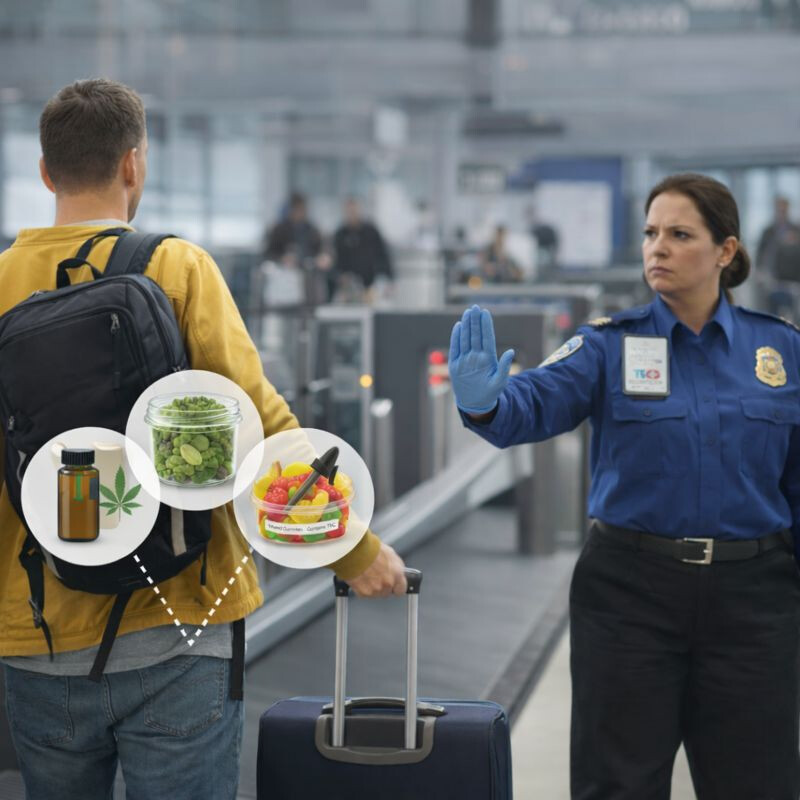
According to TSA’s official guidance, “TSA security officers do not search for marijuana or other illegal drugs.” TSA security officers focus on detecting threats to aviation security (explosives, weapons, and other dangerous items) rather than conducting drug enforcement operations. However, the agency emphasizes that marijuana and cannabis-infused products remain illegal under federal law, and officers are required to refer any suspected violations to law enforcement.
This creates a critical distinction: TSA won’t target cannabis in your luggage, but if officers discover it during routine security screening for other threats, they must report it to airport police. The outcome depends entirely on which law enforcement agency responds and what jurisdiction governs the airport.
The Federal vs. State Law Conflict
The fundamental legal tension stems from federal supremacy over aviation. Once you pass through airport security checkpoints, you enter federal jurisdiction where the Controlled Substances Act applies, regardless of state cannabis laws.
Airports operate as federal property under 14 CFR 91.19, which prohibits operation of civil aircraft with knowledge that marijuana is aboard. This means:
Federal airspace is federal territory: State laws permitting cannabis possession do not apply in airport sterile areas or during flights
TSA checkpoints enforce federal standards: Security screening operates under Department of Homeland Security authority
Local enforcement creates variability: Airport police departments enforce state law, creating a jurisdictional friction point
For example, Los Angeles International Airport (LAX) permits adults 21 and older to possess up to 28.5 grams of marijuana flower within the terminal under California state law. However, TSA checkpoints at LAX remain federally controlled, meaning officers must still refer cannabis discoveries to law enforcement—even though local police typically choose not to pursue charges for state-legal amounts.
In contrast, airports in states where cannabis remains illegal may result in arrest or citation when TSA refers passengers to local authorities.
Can You Fly With Weed From Legal State to Legal State?
The “Interstate Commerce” Myth
A common misconception holds that flying between two states with legal cannabis programs eliminates federal prohibition. This is incorrect. Any flight crossing state lines, even between California and New York, both recreational-legal states, involves interstate commerce and federal airspace, making cannabis transport technically illegal under federal law.
The Commerce Clause grants federal authority over interstate movement, and the Controlled Substances Act (CSA) is the federal law that makes transporting marijuana across state boundaries a federal offense. Evidence from legal analyses confirms that “transporting cannabis across state lines violates the Commerce Clause and the Controlled Substances Act. Even if both states have identical legalization laws, crossing the border constitutes a federal felony.”
This applies regardless of:
Whether departure and arrival states both permit recreational use
Distance traveled (short flights within neighboring legal states face identical prohibition)
Quantity possessed (personal-use amounts remain federally illegal in transit)
Why Enforcement is Low on Domestic Flights
Despite technical illegality, actual enforcement of personal-use cannabis possession on domestic flights remains relatively uncommon in states with legal marijuana programs. Several factors explain this enforcement pattern:
Law enforcement jurisdiction limitations: When TSA refers a cannabis discovery to airport police in Los Angeles, Denver, or Seattle, the responding officers enforce state law. Since possession is legal under state statutes, local police often lack authority or interest in pursuing charges for amounts within state limits.
Research on airport enforcement patterns shows that “local police at departure airports often lack jurisdiction to arrest passengers if possession is legal in that state.” This creates de facto tolerance zones at airports in legal states, though federal law technically remains violated.
TSA resource prioritization: Security screening focuses on detecting explosives and weapons that pose immediate threats to aviation safety. Drug interdiction falls outside TSA’s primary mission, leading to operational policies that don’t allocate resources to cannabis searches.
Prosecutorial discretion: Even when federal violations occur, U.S. Attorneys rarely pursue simple possession cases involving small personal amounts on domestic flights. Federal prosecution resources target trafficking operations rather than individual travelers.
Important limitations: This enforcement leniency does NOT apply to:
Airports in states where cannabis remains illegal (Texas, Georgia, Florida non-medical possession)
International flights (Customs and Border Protection enforces zero-tolerance policies)
Large quantities suggesting distribution intent
Checked baggage (discussed below—higher risk profile)
Can You Fly With Marijuana Edibles?
Why Edibles Are the Safest Method for Travel
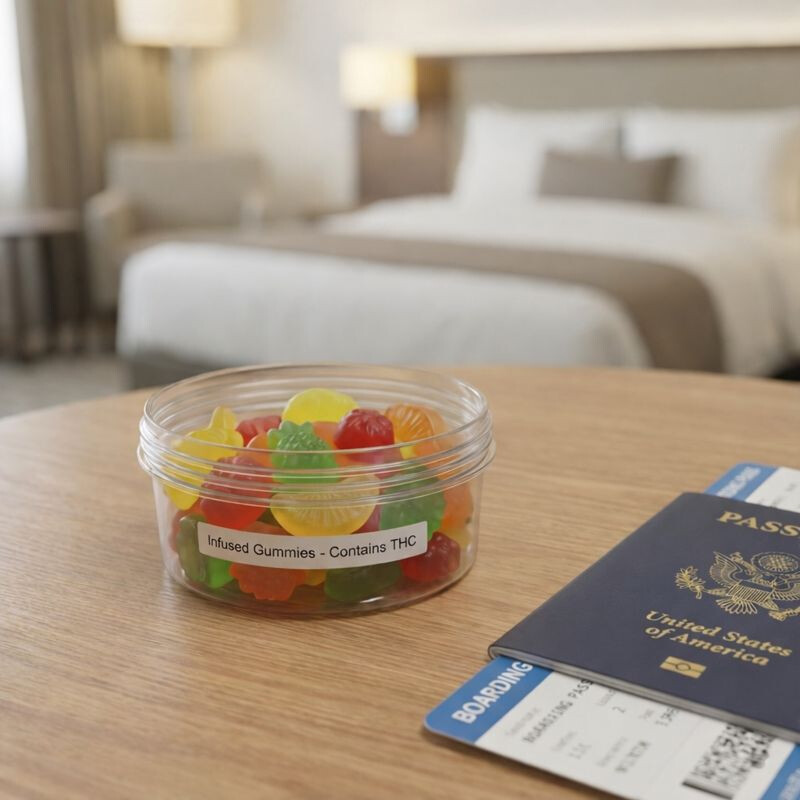
Among cannabis product forms, edibles present the lowest detection risk during airport security screening, though they remain federally illegal for THC content exceeding 0.3%. Several factors contribute to this risk profile:
Absence of distinctive odor: Unlike cannabis flower, which produces strong aromatic compounds that can alert security personnel or trigger drug-detection canines, edibles typically emit minimal cannabis-specific scent when properly packaged.
Visual similarity to conventional food: Gummies, chocolates, and baked goods infused with THC appear nearly identical to non-infused counterparts during visual inspection and X-ray screening. TSA officers cannot distinguish between a CBD gummy, THC gummy, and vitamin gummy through standard screening technology.
Reduced organic mass density: Individual edible pieces present smaller, less dense organic signatures on CT scanners compared to large quantities of cannabis flower or concentrates, making them less likely to trigger automated threat detection algorithms.
Research on TSA screening capabilities confirms that “X-rays cannot distinguish between a CBD gummy, THC gummy, and vitamin gummy” without chemical analysis, which TSA does not conduct at checkpoints.
However, travelers should understand that reduced detection risk does not equal legality. Federal law still prohibits THC edibles, and discovery can lead to law enforcement referral.
Solid vs. Liquid Edibles (The 3-1-1 Rule)
A critical regulatory distinction exists between solid and liquid cannabis edibles regarding carry-on luggage:
Solid edibles (gummies, chocolates, brownies, cookies):
Allowed in carry-on and checked baggage without volume restrictions
Subject only to standard food inspection if selected for additional screening
No special liquid container requirements apply
Liquid or gel edibles (syrups, honey, beverages, tinctures):
Must comply with TSA’s 3-1-1 liquids rule for carry-on baggage
Each container limited to 3.4 ounces (100ml) or less
All liquid containers must fit in a single quart-sized clear plastic bag
Beverages exceeding 3.4oz will be confiscated regardless of cannabis content
For example, a 12-ounce cannabis-infused beverage will be removed at security, not necessarily because TSA identified it as cannabis, but because it violates liquid volume restrictions. This confiscation occurs before any cannabis-related enforcement question arises.
Cannabis oils and tinctures packaged in dropper bottles fall under liquid rules and must remain under 3.4oz in carry-on. Larger bottles should be placed in checked luggage, though this carries separate risks discussed in the checked baggage section.
Edible Type | TSA Classification | Carry-On Status | Volume Limit |
|---|---|---|---|
Gummies, chocolates | Solid food | Permitted (subject to cannabis laws) | No limit |
Brownies, cookies | Solid food | Permitted (subject to cannabis laws) | No limit |
Syrups, tinctures | Liquid | Must follow 3-1-1 rule | 3.4oz (100ml) max per container |
Beverages | Liquid | Must follow 3-1-1 rule | 3.4oz (100ml) max per container |
Cannabis honey | Liquid/gel | Must follow 3-1-1 rule | 3.4oz (100ml) max per container |
Can You Fly With Marijuana Gummies?
Packaging and Discretion
Marijuana gummies present unique packaging considerations that affect detection probability during security screening. Several strategic approaches can reduce visibility:
Original packaging removal: Many commercial THC gummies feature obvious cannabis branding—marijuana leaf symbols, “Contains THC” warnings, or dispensary labels. Removing these identifiers and repackaging in generic containers or mixing with regular candy can reduce immediate visual recognition during bag searches.
However, this approach carries legal risks: if law enforcement questions arise, lack of original packaging makes it difficult to prove product origin or legal hemp-derived status. The strategy trades detection probability for documentation capability.
Mixing with non-cannabis gummies: Combining THC gummies with CBD gummies or regular vitamin gummies in a single container creates visual ambiguity. Security officers conducting manual bag checks cannot distinguish products without chemical testing.
Factory-sealed compliant products: For hemp-derived gummies containing ≤0.3% THC (discussed in hemp exemption section), maintaining factory-sealed packaging with clear “Hemp Derived” labeling and Certificate of Analysis information provides legal protection if questioned.
Research notes that travelers using discretion strategies should “remove ‘THC’ warning labels and mix with regular gummy bears” to reduce visual detection, though this applies primarily to state-legal scenarios rather than providing federal law compliance.
TSA Scanners and Organic Material
Modern airport security employs Computed Tomography (CT) scanners that analyze baggage contents using density and effective atomic number measurements. These systems create challenges and opportunities for cannabis edibles:
Organic mass detection capabilities: CT scanners identify materials based on atomic composition. Cannabis gummies, like all organic compounds, appear in characteristic color ranges (typically orange or brown) on screening monitors. However, this detection is non-specific; Gummies, nuts, dried fruit, energy bars, and many snacks generate similar organic signatures.
Automated threat recognition limitations: Scanner algorithms flag dense organic masses that match explosive material density profiles. A large consolidated bag of gummies may trigger automated alarms because certain plastic explosives share similar density characteristics with concentrated organic material.
Analysis of airport screening technology confirms that “cannabis edibles and dense flower buds share similar density and atomic characteristics with explosive materials. A large bag of gummies appears on CT monitors as a dense, orange organic mass,” potentially triggering manual bag searches.
Chemical analysis absence: TSA does not employ chemical testing at checkpoints. Officers cannot determine whether gummies contain THC, CBD, or no cannabinoids through available screening equipment. Discovery occurs only through visual identification of packaging labels during physical bag searches triggered by other screening anomalies.
Can You Fly With Marijuana Vape?
The Lithium Battery Rule (Safety Alert)
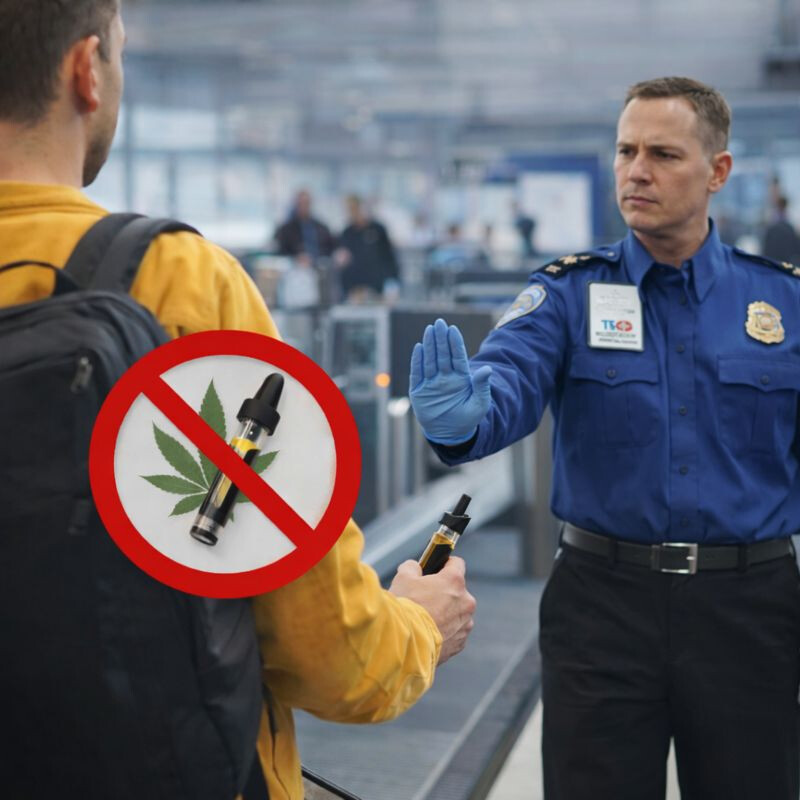
CRITICAL SAFETY REQUIREMENT: Vape devices containing lithium-ion batteries MUST be carried in cabin baggage only. Checked baggage storage is prohibited du e to fire hazard risks.
Federal Aviation Administration (FAA) regulations under 49 CFR 175.10 classify lithium batteries as hazardous materials requiring specific transport protocols:
Carry-on requirement: All vape pens, cartridge batteries, and similar devices must remain in the passenger cabin where crew can respond to potential thermal events
Checked bag prohibition: Batteries in checked luggage cargo holds pose uncontrolled fire risks with no immediate suppression capability
Enforcement: Bags found containing lithium batteries during checked baggage screening will be opened, batteries removed, and passengers paged to retrieve items, potentially drawing attention to all bag contents including cannabis products
This safety rule applies regardless of cannabis content. Even legal hemp vape devices must follow battery transport restrictions.
Separating the Cartridge from the Battery
Disassembling vape components can reduce detection probability during security screening:
Component separation strategy:
Remove cartridge from battery unit before packing
Store battery with electronics (phone chargers, power banks)
Place cartridge separately or in toiletries bag
This dispersion prevents recognition as a complete vape device
Liquid classification: Vape cartridges containing cannabis oil fall under TSA liquid rules:
Each cartridge must be ≤3.4oz (100ml)—standard cartridges (0.5g-1g) easily comply
All cartridges must fit in the single quart-sized liquids bag for carry-on
Larger oil containers must go in checked baggage (with associated risks)
Visual inspection considerations: Separated components appear less obviously cannabis-related during bag searches. A lone battery resembles any electronic device; a cartridge among other small liquid containers attracts less attention than an assembled vape pen.
However, detection risk remains. Cannabis oil cartridges often feature distinctive amber coloring and may carry residual cannabis odor detectable during close inspection.
Can You Fly With Marijuana Flower?
The “Smell” Factor (High Risk)
Cannabis flower presents the highest detection risk among all product forms during airport security screening, primarily due to aromatic compound emission:
Odor permeability: Even in sealed containers, cannabis flower releases terpenes and other volatile organic compounds that penetrate packaging materials over time. This scent can alert security personnel or drug-detection canines during screening.
Research confirms that “odor is the #1 reason bags get pulled for manual search” when cannabis flower is present. Vacuum-sealed packaging reduces but does not eliminate odor transmission, particularly for longer storage periods before travel.
Security officer training: While TSA officers don’t actively search for cannabis, they recognize the distinctive smell from routine screening experience. Strong cannabis odor emanating from luggage creates probable cause for manual inspection, transforming passive screening into active discovery.
Canine detection capabilities: Although many airports have shifted drug-detection dog programs away from marijuana (focusing exclusively on explosives in some locations), dual-purpose dogs trained for both explosives and narcotics still operate in many facilities. These animals can detect cannabis odor through most packaging materials.
The fundamental challenge: flower’s aromatic nature creates involuntary disclosure that occurs before any deliberate search takes place.
Organic Matter on Scanners
Beyond odor, cannabis flower creates distinctive X-ray and CT scanner signatures:
Dense organic mass appearance: Tightly packed cannabis buds present as concentrated organic material with characteristic density ranges on scanner displays. This appearance triggers automated threat algorithms designed to flag potential organic explosives.
Manual inspection triggers: When scanners cannot resolve a dense organic mass, security protocols require physical bag inspection. Analysis notes that “dense bud looks conspicuous on X-ray,” necessitating officer examination to rule out explosive threats.
Airtight storage protocols: Travelers attempting to transport flower should use:
Multiple layers of sealed containers (though this doesn’t guarantee success)
Vacuum-sealed bags to compress material and reduce air gaps
Opaque packaging to prevent visual identification if bags are opened
Storage among other dense organic items (coffee, tea, dried foods) to create visual ambiguity
However, even optimal packaging cannot eliminate detection risk. The combination of odor potential and organic mass density makes flower the highest-risk cannabis form for air travel.
What Happens if TSA Finds Marijuana?
The Procedure: Referral to Law Enforcement
When TSA security officers discover what appears to be marijuana during screening, a standardized protocol activates:
Step 1: Threat verification The officer first confirms the substance poses no security threat (not explosives or weapons). This initial assessment focuses on aviation safety rather than drug enforcement.
Step 2: Law enforcement notification TSA contacts airport law enforcement dispatch, requesting an officer response to the checkpoint. TSA’s authority extends only to identifying potential violations—they cannot arrest passengers or seize evidence for criminal prosecution.
Step 3: Law enforcement assumption of jurisdiction The responding police officer (local municipal police, airport authority police, or in some cases federal agents) assumes control of the situation. TSA’s involvement ends at this point.
Step 4: Enforcement decision The outcome depends entirely on the law enforcement agency’s policies and the applicable state law. TSA officials confirm that “TSA security officers do not search for marijuana or other illegal drugs” and that officers “refer the matter to law enforcement” when discoveries occur.
This referral mechanism creates the critical variability in enforcement outcomes discussed below.
Scenario A: Departing from a Legal State
In states where cannabis possession is legal for adults, airport police responses to TSA referrals typically follow one of these patterns:
No violation under state law: If the passenger possesses an amount within state legal limits and meets age requirements, local police often determine no state crime has occurred. For example:
Los Angeles (LAX): LAPD officers verify the passenger is 21+ and possesses ≤28.5g flower or ≤8g concentrate. If compliant with California limits, the passenger typically proceeds with their property, though officers may warn about federal law.
Denver, Seattle, Portland: Similar protocols in other legal states where airport police enforce state statutes rather than federal prohibition.
Disposal or return to vehicle: Even when police won’t pursue charges, they may request voluntary disposal in airport amnesty boxes or require the passenger to return cannabis to their vehicle rather than proceeding through security.
Documentation and release: Some departments document the encounter for records but allow the passenger to board after removing cannabis from their possession.
Important limitation: This leniency applies only to state legal limits. Possession exceeding state thresholds (30g+ in many states) can result in state charges even in legal jurisdictions. Additionally, federal law technically remains violated, and federal agents could theoretically pursue charges, though this rarely occurs for personal amounts.
Scenario B: Departing from an Illegal State
States without legal recreational cannabis programs enforce prohibition through airport police:
Texas (DFW, IAH): Possession of any amount of marijuana flower is a Class B misdemeanor; possession of concentrates (vape cartridges, wax) constitutes a felony regardless of weight under Texas law. TSA referrals typically result in arrest or citation.
Georgia (ATL): Possession remains a misdemeanor arrestable offense. Airport police routinely charge passengers found with cannabis.
Florida (MIA, MCO): Without medical authorization, recreational possession is illegal. Arrests and citations occur regularly at Florida airports.
Alabama, Tennessee, South Carolina: Similar prohibition enforcement with arrest as the standard outcome for TSA referrals.
Legal analysis confirms that “in states where cannabis is illegal, possession at the airport likely violates state law. The referral leads to confiscation, citation, or arrest.”
Consequences in prohibition states may include:
Immediate arrest and booking
Missed flight and travel disruption
Criminal record for drug possession
Fines ranging from hundreds to thousands of dollars
Potential jail time depending on quantity and prior record
The enforcement certainty in these jurisdictions creates substantially higher risk compared to legal-state departures.
Alternatives to Flying With Marijuana
Buying at Your Destination
The safest legal approach for cannabis users traveling to legal states involves purchasing products upon arrival rather than transporting them:
Dispensary locator apps and services:
Leafly: Comprehensive database of licensed dispensaries with user reviews, product menus, and operating hours
Weedmaps: Similar functionality with real-time inventory and online ordering capabilities for pickup
Jane Technologies: Platform used by many dispensaries for online ordering and delivery where legal
Delivery services in legal states: Many jurisdictions permit cannabis delivery to accommodations, eliminating the need to visit physical dispensaries. Services operate through licensed retailers and verify age/ID upon delivery.
Verification of legitimate sources: Only purchase from state-licensed dispensaries and delivery services. These businesses:
Verify age and ID before sales
Sell tested products with cannabinoid content verification
Provide Certificates of Analysis showing compliance with state testing requirements
Maintain legal operation under state regulatory frameworks
This approach eliminates all air travel legal risks while ensuring access to regulated, tested cannabis products at destinations.
Traveling with Hemp-Derived CBD
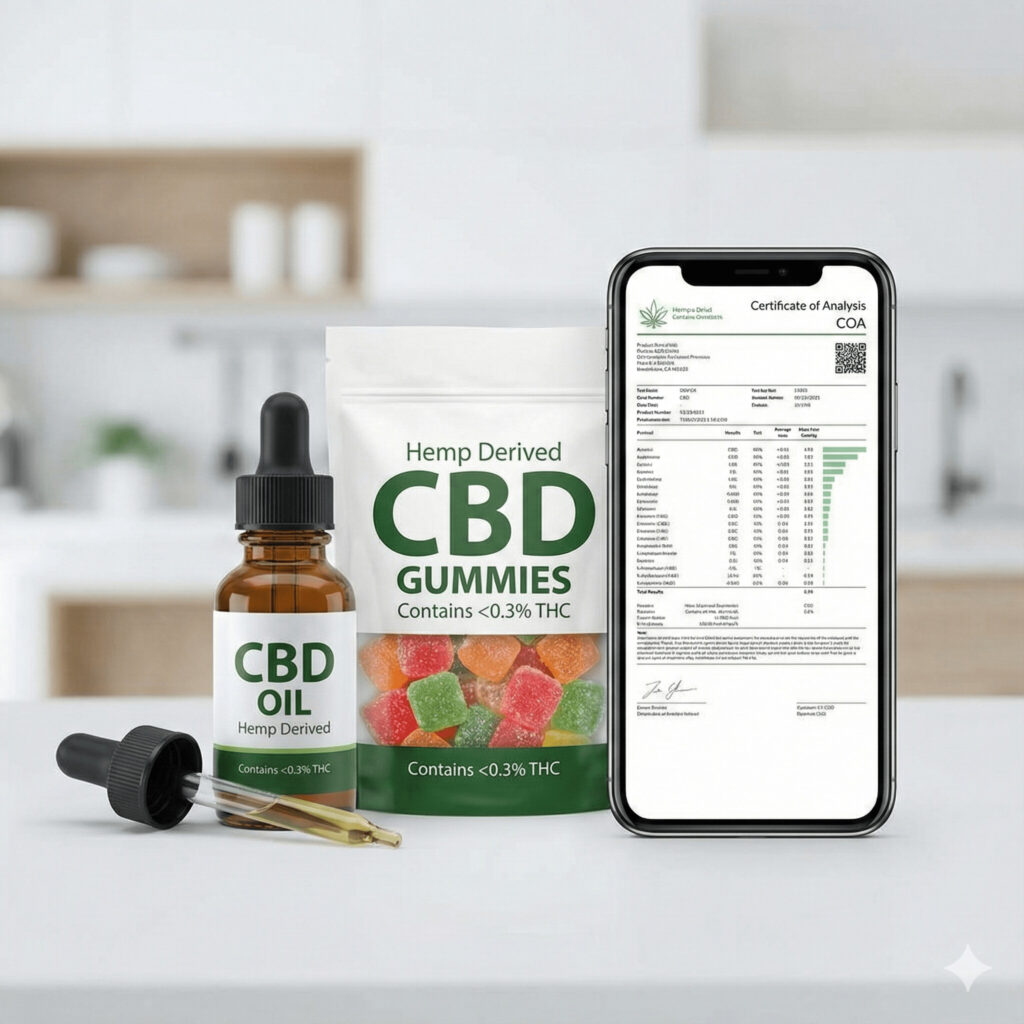
The Agriculture Improvement Act of 2018(Farm Bill) created the only federally legal pathway for flying with cannabinoid products by distinguishing hemp from marijuana based on THC concentration:
The 0.3% Delta-9 THC threshold: Hemp is defined as Cannabis sativa L. containing no more than 0.3% Delta-9 THC on a dry weight basis. Products meeting this definition:
Are not controlled substances under federal law
Are permitted in airport sterile areas and on aircraft
Must still comply with TSA liquid rules (≤3.4oz containers in carry-on)
Should be accompanied by Certificates of Analysis (COA) documenting THC content
CBD product categories:
CBD Isolate: Contains 0.0% THC—safest option with no federal legal concerns
Broad Spectrum CBD: Contains multiple cannabinoids but zero THC through processing
Full Spectrum CBD: Contains up to 0.3% THC along with other cannabinoids. Legal but may theoretically trigger rudimentary field tests that detect presence rather than quantity
Hemp-derived Delta-9 THC edibles: Manufacturers have utilized the “dry weight” definition to create federally compliant products that still produce psychoactive effects. For example, a 5-gram gummy can legally contain up to 15mg Delta-9 THC (15mg = 0.3% of 5,000mg total weight).
Analysis confirms that “hemp-derived Delta-9 THC: Manufacturers have utilized the ‘dry weight’ definition to create compliant edibles that still produce a high” while remaining federally legal for air travel.
Documentation requirements:
Carry physical copies of COAs (Certificates of Analysis) from third-party laboratories
Ensure batch numbers on packaging match COA batch numbers
Maintain factory-sealed packaging clearly labeled “Hemp Derived” and showing <0.3% THC compliance
Print backup documentation. QR codes may not function in areas with limited connectivity
This hemp exemption provides the only fully legal method for flying with cannabinoid products in federal jurisdiction.
Airport Amnesty Boxes
Several airports in legal states have installed voluntary disposal receptacles to allow passengers to discard cannabis before security screening:
Available locations:
Chicago O’Hare (ORD) and Midway (MDW): Blue amnesty boxes positioned before security checkpoints
Las Vegas Harry Reid International (LAS): Green disposal containers at terminal entry points
Colorado Springs Airport (COS): Boxes available before security areas
Notable exception—Denver International (DEN): Despite Colorado’s legal status, DEN prohibits cannabis possession on all airport property, not just beyond security. No amnesty boxes exist inside terminals; disposal must occur before entering airport premises.
Function and protections: These receptacles allow voluntary disposal without law enforcement interaction, penalty, or questioning. Once deposited, items cannot be retrieved. The boxes provide a last-resort option for travelers who arrive at airports with cannabis and choose to avoid TSA screening risks.
Analysis confirms that “amnesty boxes before international checkpoints allow disposal of cannabis before leaving Canada, an indication that domestic carry is expected, but leaving the country with it is not.”
