
Table of Contents
The quickest way to identify a male vs. female cannabis plant is to look at the nodes — the points where branches connect to the main stem. If you’re growing cannabis from regular seeds, you need to identify which plants are male and which are female—and you need to do it early.
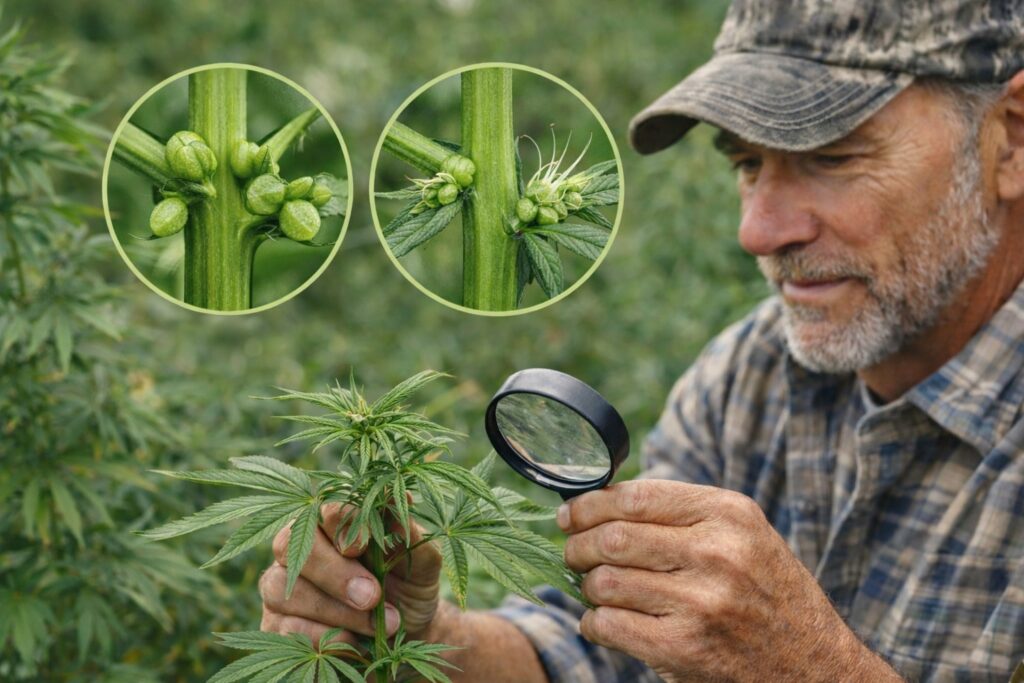
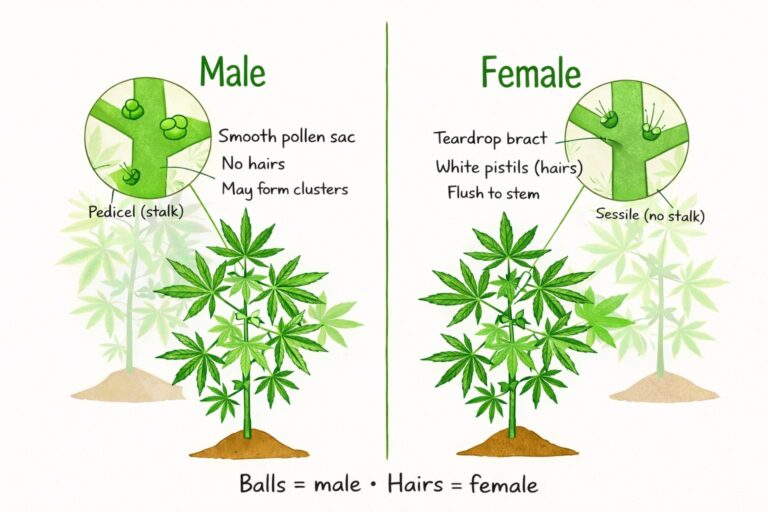
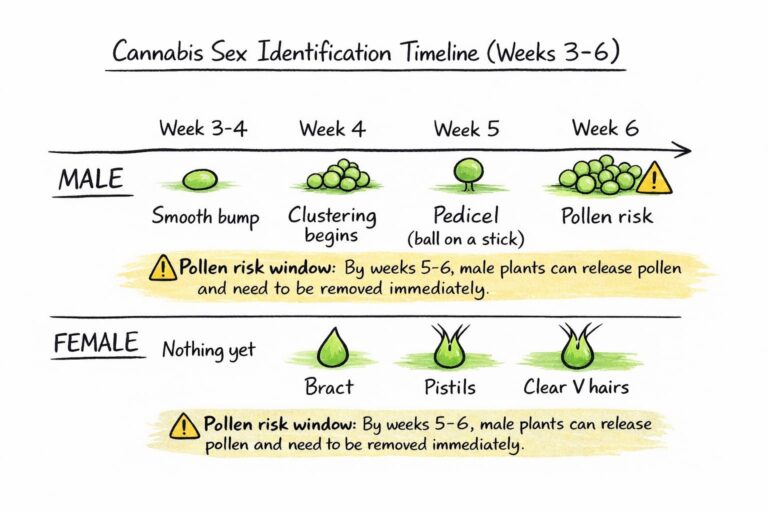
What you’re looking for: Around week 3-4 of growth, check the nodes—those spots where branches connect to the main stem. Males develop small, smooth, round balls that look like tiny grapes or the spade symbol on a playing card. They never have white hairs. Females develop teardrop-shaped pods with two thin white hairs (pistils) poking out in a “V” shape, usually appearing a week or two later around weeks 4-6.
The dead-simple rule: No white hairs = male. White hairs sticking out = female.
When to check: Start inspecting your plants daily at week 3 and keep watching through week 6. Males typically show their sex 1-2 weeks before females, giving you time to act. Use a magnifying glass or jeweler’s loupe (60x magnification works best) to get a clear view—pre-flowers start tiny, about the size of a pinhead.
What to do when you spot a male: Remove it immediately, before those little balls cluster together like grapes. Once clustering happens, pollen release is only days away. Take the male plant far from your grow area before handling it—pollen is incredibly light and travels easily on clothing, fans, and air currents.
That’s the core of what you need to know. If you catch males before week 5-6, you’ll protect your female plants and ensure they can focus all their energy on producing high-quality, seedless buds. Check daily, trust what you see, and when in doubt, wait 3-5 days and look again—pre-flowers develop quickly, and what seems unclear on Monday often becomes obvious by Friday.
Want to Go Deeper? Complete Guide to Cannabis Sex Identification
You now know enough to identify and remove males. The sections below provide comprehensive details on plant development stages, visual identification techniques, timing factors, and advanced troubleshooting—everything else you might need to know.
What Does a Marijuana Plant Look Like at Each Stage?
What Does a Baby Marijuana Plant Look Like?
A cannabis seedling emerges with two rounded embryonic leaves called cotyledons, which store nutrients from the seed and appear smooth-edged and oval. These cotyledons sustain the plant during its first 7–10 days before true leaves develop. The first true leaves display the characteristic serrated (jagged) edges and pointed tips associated with cannabis, initially appearing as a single blade or with three fingers. Seedlings remain sexually neutral during this period, typically extending from germination through week 2–3. Cannabis plants begin their life cycle without any indication of plant sex.
Structure | Appearance | Function |
|---|---|---|
Cotyledons | Round, smooth-edged, pale green | Initial nutrient storage from seed |
First true leaves | Single blade or 3 fingers, serrated edges | Photosynthesis initiation |
Hypocotyl | Thin white/green stem | Support and water transport |
What Does a Young Marijuana Plant Look Like?
Between weeks 3 and 6, your plant hits its growth spurt. Leaves get bigger and more complex — starting with 3 fingers, then 5, 7, and eventually 9 or more. The stem thickens, branches start spreading out, and the spaces between nodes (where leaves connect to the stem) get wider.
All that energy is going into building roots and a leafy canopy — basically a frame strong enough to support heavy buds later. You still can’t tell males from females at this point. The genetics are already set, but the plant won’t show visible signs until pre-flowers appear toward the end of this stage.
What Does a Weed Plant Look Like During Vegetative Growth?
During established vegetative growth, cannabis plants develop their characteristic architecture: large fan leaves with 7–11 serrated fingers, thick main stems, and lateral branches emerging from each node. The plant’s height and branching pattern begin revealing secondary sexual characteristics—though these are indicators rather than definitive markers. Fan leaves serve as solar panels for energy production, while the main stem and branches develop the structural capacity to support either pollen production or heavy flower development. Internodal spacing (the distance between nodes) and overall plant stature vary by genetics but also correlate loosely with sex, as discussed in later sections. Growing cannabis successfully requires understanding these vegetative stage patterns before attempting sex identification.
Weed Plant Stages From Seedling to Flowering
Cannabis progresses through four primary growth stages, each with distinct characteristics and care requirements. The following durations represent typical ranges and vary by strain and growing conditions:
Stage | Typical Duration | Key Characteristics |
|---|---|---|
Germination | 1–10 days | Seed swells, radicle emerges, shell cracks |
Seedling | 2–3 weeks | Cotyledons appear, first true leaves develop |
Vegetative | 3–16 weeks | Explosive growth, fan leaves expand, nodes multiply |
Flowering | 6–14 weeks | Pre-flowers appear, bud sites develop, trichomes form |
The transition from vegetative to flowering stage—triggered by light cycle changes (12 hours light/12 hours dark for photoperiod varieties) or genetic programming (autoflowering varieties)—marks the critical window for sex identification. Pre-flowers typically emerge during late vegetative growth or early flowering transition, appearing at the nodes where branches meet the main stem.
Early Signs of Male Plant
What the Early Signs of Male Marijuana Plant Look Like
Around week 3 or 4, check where the branches meet the main stem. If you see smooth little balls — about the size of a pinhead, with no hairs poking out — that’s a male. Growers describe them as “spades,” “balls,” or “crab claws” depending on the angle. The key tell: no white hairs, ever.
As males mature, two things happen. First, a small stalk develops beneath each sac, lifting it away from the node. Second, the sacs start clustering together like a tiny bunch of grapes. Once you see clustering, pollen release is days away — act fast.
When Marijuana Male Plant Signs Usually Appear
Male plants consistently reveal their sex earlier than females, typically showing pre-flowers 3–4 weeks after germination. This 1–2 week developmental advantage evolved to ensure pollen availability when female stigmas become receptive. For cultivators, this timing difference serves as an early warning system—the appearance of the first male pre-flowers signals the identification window has opened.
Factors influencing timing include: strain genetics (some cultivars mature faster), lighting conditions (more intense light may accelerate development), and environmental stress (which can alter hormonal balance and affect timing).
Where to Check for Weed Male Plant Identification
Focus inspection efforts on the nodes—the V-shaped junctions where leaf petioles and lateral branches connect to the main stem. Pre-flowers emerge in the axil of these junctions, nestled behind the stipules (small, pointed leaf-like appendages) and between the petiole and main stem.
For early detection, inspect upper nodes first. Male plants tend to develop pre-flowers higher on the plant initially. Use a jeweler’s loupe (30x–60x magnification) to examine structures smaller than 1mm. The 60x magnification level allows growers to distinguish the smooth, waxy surface of male sacs from other nodal structures.
Why Cannabis Male Plant Early Signs Matter
A single mature male plant releases millions of pollen grains capable of pollinating nearby females in an indoor growing facility or within a significant outdoor radius. When male plants pollinate females, the female plants redirect metabolic energy from trichome and cannabinoid production toward seed development. Studies indicate fertilization can reduce total cannabinoid content by roughly half or more, significantly diminishing the quality and market value of the harvest. This is why most growers prioritize early identification—to separate male plants before they can damage the entire crop.
Early identification enables:
Immediate removal before pollen release (typically 4–5 weeks after flowering initiation)
Conservation of resources (nutrients, water, lighting, space)
Protection of female crop value
Prevention of seeded, unmarketable flower
Expert Insight: “A single mature male can compromise an entire indoor growing facility or a significant radius of an outdoor field… The cost of a missed male diagnosis is essentially the value of the entire crop.” — Medicinal Genomics, When Do Cannabis Plants Show Signs of Gender/Sex?

Visual identification relies on recognizing the progressive development of male structures:
Stage 1 (Weeks 3–4): Small, smooth, round bumps appear at nodes—often described as resembling tiny green balls. No visible appendages or hairs. These early pollen sacs are the first indication of male sex.
Stage 2 (“Ball on a stick”): As pre-flowers mature, they develop short stalks (pedicels) lifting them slightly away from the stem. This structural adaptation positions sacs for optimal pollen dispersal.
Stage 3 (“Grapes”): Multiple sacs cluster at nodes, resembling bunches of grapes or small bananas. At this point, pollen release is imminent—immediate removal is critical to prevent male pollen from reaching female plants.
Early Signs of Female Plant
Early Signs of Female Marijuana Plant at the Nodes
Female plants take a bit longer to show — usually weeks 4 through 6, sometimes later depending on strain. Look for a teardrop-shaped structure (the bract) with two white or pinkish hairs poking out in a V shape. Those hairs are pistils, and they’re your confirmation.
Unlike male sacs, female bracts sit directly against the stem without a stalk lifting them away — growers call this “sessile” attachment. You might also notice a faint shimmer on the bract’s surface even at this early stage; those are baby trichomes, the same resin glands that eventually frost over mature buds. If you see that shimmer forming, you’ve definitely got a female.
When Female Pre-Flowers Typically Appear
Female plants reveal their sex about 4–6 weeks after germination (sometimes later depending on strain), approximately 1–2 weeks after males. This later emergence means growers should maintain inspection protocols even after identifying and removing males. Autoflowering varieties may show sex earlier (2–4 weeks) due to their genetically programmed flowering timeline.
If no pistils are visible on a suspected female pre-flower, wait several days before making final determinations—stigmas occasionally emerge after the bract structure is already formed. Only female plants will eventually develop the resinous buds that most growers seek.
How Female Plants Develop After Early Identification
Once confirmed female, plants develop through predictable flowering phases:
Flower initiation (Weeks 1–2): Pre-flowers multiply at nodes. White pistils become more prominent. Early bud sites form where flower clusters will develop. Bud production begins as bracts stack at each node.
Mid-flowering (Weeks 3–6): Bracts swell and stack to form recognizable bud structures. Trichome density increases dramatically. Pistils remain white and erect, actively seeking pollen. Plants produce high quality flowers when kept unpollinated.
Late ripening (Weeks 7+): Trichomes progress from clear to cloudy to amber. Pistils darken from white to orange/brown and curl inward. Bracts reach maximum size and resin production peaks. The result is seedless buds with maximum cannabinoid concentration.
Male vs Female Weed Plant
Male vs Female Pre-Flowers at a Glance
Male vs Female Plant Pre-Flower Differences
The easiest way to tell males and females apart is by what they’re built to do: spread pollen or catch it.
Feature | Male (Staminate) | Female (Pistillate) |
|---|---|---|
Primary structure | Pollen sac (stamen) | Bract with pistils |
Shape | Spade, club, egg, crab claw | Teardrop, pear, pointed |
Texture | Smooth, glossy or matte green | Trichome-covered, hairy |
Appendages | Pedicel (stalk) often present | Sessile (no stalk) |
Definitive sign | No white hairs; clustering | White/pink stigmas present |
Reproductive function | Produce pollen | Catch pollen / produce buds |
Male and female flowers | Male flowers only | Female flowers only |
Weed Male vs Female Plant Growth Patterns
Beyond reproductive structures, male and female plants exhibit different vegetative characteristics:
Male plants typically display:
Greater height and faster vertical growth (“stretching”)
Wider internodal spacing (lankier appearance)
Less complex lateral branching
Thicker, woodier stems earlier in development
Sparser foliage overall with fewer leaves
Produce male flowers at nodes
Female plants typically display:
Shorter, stouter stature
Tighter internodal spacing
More extensive lateral branching (bushier canopy)
Higher leaf density, especially near growing tips
Complex branch networks supporting multiple bud sites
Produce female flowers that develop into buds
These vegetative indicators should prompt closer inspection rather than serve as sole identification criteria, as genetics cause significant variation across strains.
Cannabis Male vs Female Plant Roles in Cultivation
Female plants produce the cannabinoid-rich, terpene-dense flowers that represent the commercial and personal-use value of cannabis cultivation. When kept unpollinated, females continue producing resin in “biological frustration,” resulting in the seedless flower (sinsemilla) that defines quality cannabis.
Male plants serve essential functions in breeding programs, contributing 50% of genetic material for developing new strains. Professional breeders evaluate males for structure, vigor, drought resistance, terpene profiles, and trichome production (visible on leaves and stems). For non-breeding cultivation, males represent resource drains requiring removal. Male and female cannabis plants each have distinct roles—but for most growers focused on bud production, only female plants matter.
Difference Between Male and Female Weed Plants Explained
The differences between male and female cannabis plants extend beyond visual identification to fundamental impacts on cultivation outcomes:
Yield impact: Only females produce consumable flower. Males contribute zero usable material in non-breeding contexts and actively reduce female yields through pollination.
Potency impact: Unpollinated female flowers maintain maximum cannabinoid production. Pollinated flowers redirect energy toward seed development, with research indicating fertilization can reduce cannabinoid content by half or more. Cannabis growers prize unpollinated females because they produce high quality, cannabinoid-rich buds.
Resource impact: Males consume identical nutrients, water, light, and space as females during vegetative growth. Early identification prevents wasted inputs in the grow room.
Male vs Female Weed Plant Early Stage Comparison
Male and female plants don’t show sex at the same time. The timeline below breaks down what each looks like between weeks 3 and 6 so you know when to act.
Marijuana Plant Images and Visual Identification Guide
Marijuana Plant Images Showing Male and Female Weed Plants
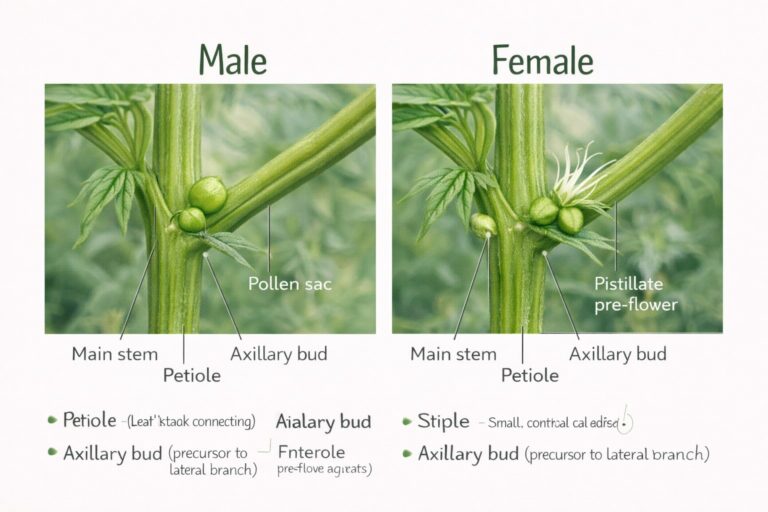
Effective visual identification requires understanding the nodal anatomy:
Node components:
Main stem (central structural column)
Petiole (leaf stalk connecting fan leaf to stem)
Axillary bud (precursor to lateral branch)
Stipule (small, pointed, leaf-like appendage)
Pre-flower (reproductive primordia behind stipule)
Pre-flowers emerge specifically in the axil—the angle between petiole and main stem—behind the stipule. Distinguishing pre-flowers from stipules prevents misidentification: stipules are flat, green, dagger-like structures; pre-flowers are three-dimensional reproductive units.
What Does a Male Marijuana Plant Look Like?
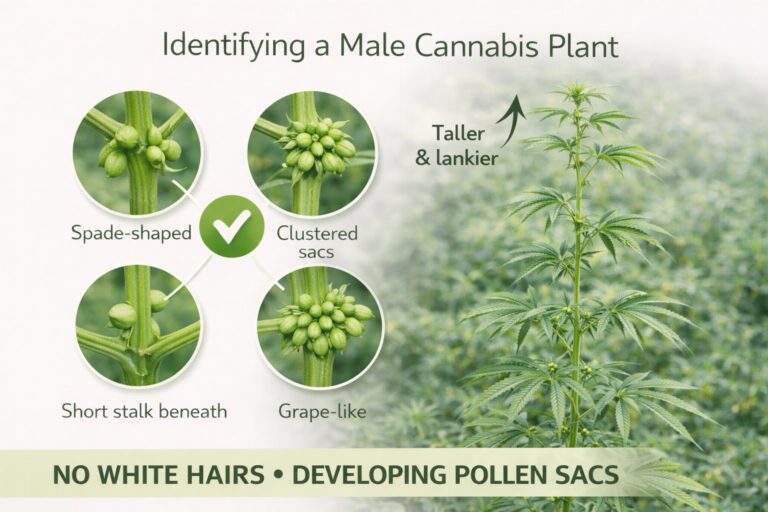
A male cannabis plant presents the following identification checklist:
[ ] Round, smooth structures at nodes (no white hairs)
[ ] “Spade” or “ball” shaped pre-flowers
[ ] Development of short stalks beneath sacs
[ ] Clustering of multiple sacs at single nodes
[ ] Taller stature with wider internodal spacing
[ ] Lankier overall appearance with less foliage
[ ] Thicker stem development relative to age
[ ] Pollen sacs that cluster in grape-like formations
What Does a Female Marijuana Plant Look Like?
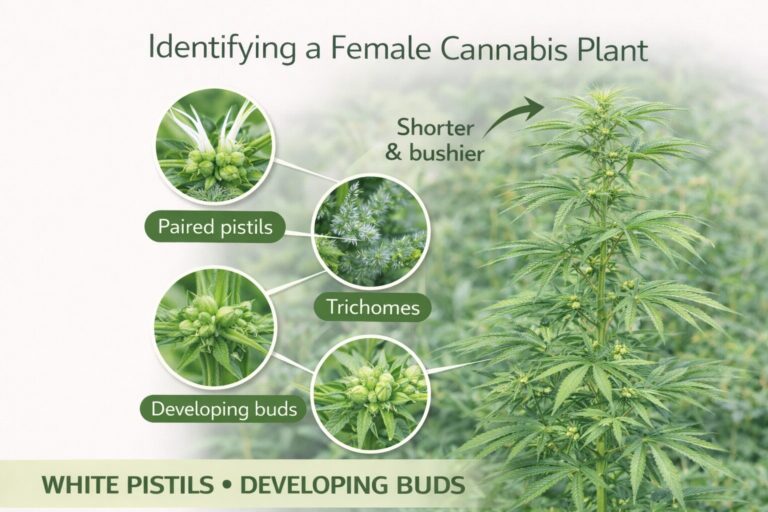
A female cannabis plant presents the following identification checklist:
[ ] Teardrop-shaped bracts at nodes
[ ] White or pinkish pistils (hairs) emerging from bract tips
[ ] “V” formation of paired stigmas
[ ] Sessile attachment (flush to stem)
[ ] Shorter, bushier growth habit
[ ] Dense foliage and complex branching
[ ] Early trichome development on bracts and nearby leaves
[ ] Will produce buds when flowering completes
First Signs of Flowering Stage
Marijuana Flowering Stage Signs vs Pre-Flowers
Pre-flowers represent sex indicators rather than true flowering. The distinction matters for timing and plant management:
Pre-flowers (late vegetative):
Appear while plant is still under vegetative light cycle
Indicate genetic sex without requiring flowering conditions
Emerge at nodes individually or in small numbers
Purpose: sex identification
True flowering signs:
Require flowering light cycle (12/12) for photoperiod varieties
Multiple flower sites develop simultaneously
Bud structure forms with stacking bracts
Trichome production increases dramatically
Purpose: reproduction/harvest
Cannabis First Flowering Stage Timeline
The initial flowering phase (“stretch phase”) occurs during the first 1–3 weeks after transitioning to flowering conditions:
Week | Development |
|---|---|
Week 1 | Rapid vertical growth (plants may double in height); pre-flowers become more prominent |
Week 2 | Stretch continues; white pistils multiply at nodes; bud sites establish |
Week 3 | Stretch slows; flower clusters begin forming; trichome production initiates |
Indoor plants typically stretch 50–100% during this phase, requiring training or space management considerations.
Pre-Flowering First Signs of Flowering Stage
The transition from vegetative to flowering displays specific signals:
Increased development of pre-flowers at most nodes
Pistils multiplying and becoming more visible
Subtle changes in leaf growth patterns (smaller new leaves)
Node spacing may tighten as stretch phase concludes
Aromatic compounds (terpenes) become more noticeable
What Does a Marijuana Plant Look Like When It Starts to Flower?
Early flowering cannabis displays:
White pistils emerging at multiple node sites simultaneously
Bud sites forming where branches meet main stem
Sugar leaves (small leaves within bud sites) appearing
Early trichome development creating slight “frostiness”
Continued pistil development with stigmas remaining white and erect
Weed Early Flowering Signs Indoors
Indoor cultivation allows precise flowering control through light cycle manipulation. When transitioning to 12/12 (12 hours light, 12 hours uninterrupted darkness):
Expect pre-flower development within 7–14 days
Female pistils should be clearly visible by day 14–21
Monitor for hermaphroditic development (discussed below)
Maintain complete darkness during dark period—even minor light leaks disrupt flowering hormones
What Does a Flowering Marijuana Plant Look Like?
Mature flowering plants display:
Dense clusters of bracts forming “colas” (flower clusters)
Abundant trichomes covering bracts and sugar leaves
Pistils progressively changing from white to orange/brown
Strong aromatic terpene production
Sugar leaves partially embedded within bud structure
Stages of Bud Growth (What to Expect)

Male Weed Plant
Marijuana Male Weed Plant Identification
Confirming male identification requires observing the full development sequence:
Initial smooth, round pre-flowers at nodes (weeks 3–4)
Development of pedicels (stalks) beneath sacs
Clustering of multiple sacs (“grape” formation)
Pollen sacs reaching full size before opening
Sac opening and pollen release (immediate removal required before this stage)
Cannabis Male Weed Plant and Pollination Risk
A single male plant poses existential risk to an entire grow operation:
One mature male releases millions of viable pollen grains
Pollen travels through ventilation systems and on clothing
Pollination diverts female energy from cannabinoid production to seed formation
Seeded buds are unmarketable in commercial contexts
Quality degradation affects both potency and terpene profile
Male pollen sacs typically reach maturity and release pollen 4–5 weeks after flowering initiation, but stressed plants may release earlier. When males pollinate females, the female plants begin producing seeds instead of maximizing resin production.
Expert Warning: “The presence of a single male plant, capable of releasing millions of pollen grains into the cultivation environment, poses an existential threat… Pollination shifts the female plant’s metabolic priority from the synthesis of resinous trichomes to the energy-intensive production of seeds, catastrophically reducing the potency, flavor, and market value of the crop.” — Jorge Cervantes, Marijuana Horticulture (paraphrased from cultivation research)
Weed Male Plant Uses in Breeding
Male plants serve essential breeding functions:
Contribute 50% of offspring genetics
Selected for desirable traits: structure, vigor, terpene profiles, disease resistance
Pollen can be collected and stored for controlled breeding
Evaluated by trichome production on leaves and stems (indicating cannabinoid potential)
Essential for developing new cultivars and maintaining genetic diversity
Used to produce feminized seeds when treated with colloidal silver
Specifically bred male specimens with exceptional traits are valuable for creating the next generation of cannabis genetics.
Male Weed Plant Stages
Stage | Timing | Characteristics |
|---|---|---|
Pre-flower | Weeks 3–4 | Smooth round bumps, “ball” appearance |
Development | Weeks 4–5 | Pedicel formation, “ball on stick” |
Clustering | Weeks 5–6 | Multiple sacs, “grape” appearance |
Maturation | Weeks 6–8 | Sacs swell, prepare to open |
Pollen release | Week 8+ | Sacs open, pollen disperses |
Female Weed Plant
Marijuana Female Weed Plant Bud Development
Female flower development follows predictable stages optimized for capturing pollen (in natural reproduction) or maximizing cannabinoid production (in cultivation):
Bract development: Individual bracts swell and stack, creating the bud structure. Each bract contains a single ovule capable of seed production if pollinated. When unpollinated, females continue developing resinous buds.
Pistil function: Stigmas (the white hairs) serve as pollen catchers. In unpollinated cultivation, they continue extending and developing, eventually darkening and retracting as the plant reaches peak maturity.
Trichome production: Glandular trichomes covering bracts and sugar leaves produce and store cannabinoids and terpenes. Maximum density correlates with optimal harvest timing.
Cannabis Female Weed Plant and Sinsemilla
Sinsemilla (Spanish: “without seed”) represents the cultivation gold standard:
Refers to unpollinated female flowers
Achieves maximum cannabinoid concentration
Results from complete male exclusion
Produces the potent, seedless flower demanded by consumers and patients
Studies show fertilization can reduce cannabinoid production by roughly half or more compared to unpollinated plants
Research Finding: “Unpollinated female plants continue to produce resin and swell their bracts for weeks, waiting for pollen that never comes. This biological frustration results in the high-THC, high-terpene flowers demanded by the market.” — Royal Queen Seeds / Leafly cultivation guides
Weed Female Plant Identification During Flowering
Confirming female identification during flowering:
Multiple bud sites developing with visible pistils
No smooth, round pollen sacs present
Bract structure with pointed tips (not globular)
Trichome development on bracts and sugar leaves
Continued pistil production as flowering progresses
Female Marijuana Plant Signs of Healthy Growth
Healthy female flower development displays:
Abundant white pistils extending actively
Progressive trichome density increase
Bud sites fattening throughout flowering
No yellowing or browning of pistils before week 6+
No presence of “bananas” or male structures (indicating hermaphroditism)
Strong, strain-appropriate aromatic development
Special Cases: Hermaphroditism
What Hermaphrodite Plants Look Like
Cannabis exhibits phenotypic plasticity allowing plants to develop both male and female reproductive organs under certain conditions, and stress‑induced ‘bananas’ or mixed‑sex flowers are well documented in cultivation literature. Two primary forms exist:
True hermaphrodites: Develop independent male pollen sacs and female flowers at different nodes. Male sacs appear as typical smooth, round clusters separate from female bud sites. These hermaphroditic plants display both male and female flowers on the same plant.
“Bananas” or “nanners”: Exposed male anthers (stamens) emerge directly within female buds. These curved, yellow structures lack the protective sac covering and can release pollen immediately upon emergence—making them particularly dangerous.
Causes of Hermaphroditism
Research from cannabis genetics specialists and breeder stress-testing confirms that the following factors can trigger hermaphroditic development:
Genetics: Some strains carry genetic predisposition; seeds from hermaphroditic plants often inherit the trait
Light stress: Interruption of dark periods (even from indicator LEDs) disrupts flowering hormones, and inconsistent light schedules or light leaks are among the most common triggers for hermaphroditic ‘nanners’ in photoperiod strains.
Temperature stress: Temperatures exceeding about 85°F (29°C) or severe fluctuations can trigger stress responses linked to hermaphroditism and ‘nanners,’ especially when combined with other environmental problems.
Root zone issues: Root rot, pH imbalances, being root-bound
Nutrient stress: Deficiencies or toxicities during flowering
Late-harvest stress (rodelization): Unpollinated plants left past peak maturity may self-pollinate as survival mechanism
Managing Hermaphrodite Plants
The following approaches represent common grower practice rather than lab-tested protocols, but are widely used in both commercial and home cultivation settings:
Cull approach: Remove and destroy hermaphroditic plants immediately during early to mid-flowering. The risk of crop-wide pollination exceeds any single plant’s yield value.
Pluck approach: For late-flowering hermaphrodites showing only scattered “nanners,” careful removal with tweezers may salvage the harvest. Mist the area with water (which neutralizes pollen) before removal. This approach carries risk—missed nanners can still cause seeding.
Advanced Identification Methods
DNA Sex Testing Before Visual Signs
Genomic testing using qPCR (quantitative Polymerase Chain Reaction) detects Y‑chromosome markers in plant tissue as early as the first true leaves, allowing cultivators to identify male plants weeks before visual pre‑flowers appear:
Method | Timing | Accuracy | Cost | Best For |
|---|---|---|---|---|
DNA testing (qPCR) | Weeks 1–2 | ~99% (in controlled conditions) | High | Commercial operations |
Visual inspection | Weeks 4–6 | Variable | Free | Home growers |
Magnification (60x) | Weeks 3–5 | High | Low | Standard practice |
Clone forcing | Weeks 4–5 | 100% | Medium | Confirmation before flower |
The Clone Method for Sex Confirmation
For growers wanting sex confirmation before visual pre-flowers:
Take small cutting (clone) from vegetative mother plant
Place clone under immediate 12/12 light cycle in separate space
Clone reveals sex within 1–2 weeks
Since clone shares mother’s genetics, mother’s sex is confirmed
Mother plant continues vegetative growth undisturbed
Using Magnification Tools
Jeweler’s loupe recommendations:
30x magnification: General node survey, quick scanning
60x magnification: Optimal for sexing; reveals surface texture differences
100x+ magnification: Too powerful for handheld use; minimal practical benefit
Digital microscopes allow screen viewing and image capture for documentation or second opinions.
Autoflowering and Feminized Seeds
Feminized Seeds and Sex Identification
Feminized seeds are specifically bred to produce female plants with near-100% reliability, eliminating most sex identification concerns. These seeds are created by inducing female plants to produce feminized seeds through controlled stress or chemical treatment (colloidal silver), resulting in seeds that produce female plants. However, stress-induced hermaphroditism remains possible, requiring continued monitoring.
Autoflowering Varieties
Autoflowering cannabis flowers based on age rather than light cycle, typically showing sex 2–4 weeks after germination. Earlier sex expression simplifies identification but also reduces the response window for removing males.
Common Mistakes in Plant Identification
Misidentifying Stipules as Pre-Flowers
The stipule—a pointed, leaf-like appendage at node bases—frequently confuses beginners:
Feature | Stipule | Pre-flower |
|---|---|---|
Shape | Flat, dagger-like | 3D structure (ball or teardrop) |
Texture | Green, leafy | Smooth (male) or hairy (female) |
Position | Adjacent to pre-flower site | Behind stipule in axil |
Function | Non-reproductive | Reproductive |
Too Early to Tell? What to Wait For
If identification remains uncertain:
Wait 3–5 additional days for further development
Use magnification to examine texture
Look for the emergence of white hairs (female) or clustering of smooth balls (male)
Consider clone forcing for definitive confirmation
Avoid removing plants based solely on secondary characteristics (height, branching)
Stress Signals vs. Sex Signals
Environmental stress can cause atypical development:
Nutrient deficiencies may stunt pre-flower development
Light stress can delay or alter flowering signals
Temperature extremes may trigger hermaphroditism
Distinguish stress-related abnormalities from sex-related structures by examining multiple nodes
FAQs About Marijuana Plant Identification
How to tell if a plant is male or female early?
Knowing how to tell if marijuana plant is male or female early comes down to one simple check: look at the nodes starting around week 3–4. Male plants show smooth, round balls with no hairs. Female plants show teardrop-shaped pods with white hairs poking out in a V shape. If you’re wondering how to tell if weed plant is male or female early, use a 60x jeweler’s loupe — it makes spotting these tiny structures much easier. The cannabis male or female early signs are subtle at first but become obvious within a few days of appearing.
When do marijuana plants show male or female signs?
Males reveal themselves first — typically around weeks 3–4 after germination. Females follow about 1–2 weeks later, usually weeks 4–6. This marijuana male or female signs week timing varies by strain: some fast-maturing genetics show earlier, while others take longer. Autoflowering varieties may show sex as early as week 2–3. Understanding the cannabis male or female timeline helps you know when to start daily inspections. If you’re asking when do weed plants show male or female signs, the short answer is: start checking at week 3 and don’t stop until week 6.
Can you tell male vs female weed seeds?
No — there’s no way to tell male vs female marijuana seeds just by looking. Seeds don’t show any visual differences regardless of the sex they’ll grow into. The only exception is feminized seeds, which are bred specifically to produce female plants. With regular seeds, expect roughly 50/50 male and female. Anyone claiming they can identify cannabis male vs female seeds identification by shape, size, or color is mistaken. If you’re searching for weed seeds male or female signs, the honest answer is those signs don’t exist until the plant actually grows and develops pre-flowers.
How to avoid pollination from male weed plant?
The key to keeping female weed plant from pollination is early detection and immediate removal. Once you spot male pre-flowers, remove that plant before the sacs cluster — clustering means pollen release is days away. For extra protection: use feminized seeds to reduce male occurrence, keep breeding projects in separate spaces with dedicated equipment, and change clothes before moving between grow areas. Knowing how to avoid pollination from male marijuana plant also means watching for hermaphrodites throughout flowering. Cannabis pollination prevention male plant strategies work best when you check plants daily during weeks 3–6.
Why early signs of male plant and early signs of female plant matter for growers?
Early signs of male marijuana plant importance boils down to one thing: catching males before they can release pollen saves your entire harvest. A single male can pollinate every female in your grow space, turning seedless buds into seeded, less potent flower. Early signs of female marijuana plant importance is about confirming which plants deserve your resources — light, nutrients, space, and attention. Cannabis grower early plant signs recognition also prevents wasted weeks of feeding plants that won’t produce usable flower. The earlier you identify sex, the more time and money you save.
What are the first signs of marijuana flowering stage indoors vs outdoors?
Indoors, the first signs of cannabis flowering indoors appear 7–14 days after switching to a 12/12 light cycle. You’ll see pre-flowers developing at nodes, rapid vertical stretching, and pistils multiplying over the first 2–3 weeks. The first signs of cannabis flowering outdoors follow a natural trigger — when daylight drops below about 14 hours (late summer in most northern locations). Development follows similar patterns, but timing depends on your latitude. Whether you’re watching for weed flowering stage early signs indoor vs outdoor, the key markers are the same: more pre-flowers, visible pistils, and the beginning of the stretch phase.
What if I see both balls AND hairs on the same plant?
You’ve got a hermaphrodite — a plant showing both male and female parts. This usually happens when females get stressed by light leaks, temperature swings, root problems, or nutrient issues. Hermaphrodites can pollinate themselves and every female nearby. If you catch it early (just one or two sacs), carefully pluck them with tweezers and monitor closely. If male structures are widespread, remove the entire plant to protect your crop.
I think I see pre-flowers, but I’m not 100% sure. What should I do?
Wait 3–5 days and check again. Pre-flowers develop quickly, and something ambiguous on Monday often becomes obvious by Friday. Take daily photos so you can compare. If you’re still uncertain after a week, the plant is probably a late bloomer — some strains just take longer. Don’t remove a plant based on uncertainty; patience prevents mistakes.
My plant was definitely female, but now I see banana-shaped things in the buds. What happened?
Those are “nanners” — male anthers that emerge from female flowers under late-flowering stress. Unlike full pollen sacs, nanners release pollen immediately without needing to open. Check for light leaks, heat stress, or whether you’ve let the plant flower past its harvest window. Remove nanners with tweezers if scattered, but if they’re everywhere, harvest immediately to minimize seeding.
I removed a male but seeds still showed up in my female buds. What went wrong?
Pollen travels farther than most growers expect. If the male opened even one sac before removal, fans or air movement could have spread pollen across your space. Males can also release pollen earlier than they appear ready — sometimes sacs that look immature are already shedding. For future grows, remove males at the first sign of clustering, before stalks elongate beneath the sacs.
What’s the difference between a bract and a calyx?
Growers often use “calyx” to mean the teardrop-shaped pod where pistils emerge, but botanically that’s the bract. The true calyx is a tiny, nearly invisible membrane inside that surrounds the seed. Use whichever term you prefer — just know you’re looking for the swollen, often frosty structure at the base of each pistil pair.
Quick Reference: Early Signs Cheat Sheet
Male indicators:
Smooth, round structures at nodes
“Spade,” “ball,” or “crab claw” shapes
No white hairs
Development of stalks beneath sacs
Clustering like “grapes”
Typically appears about weeks 3–4 (varies by strain)
Female indicators:
Teardrop-shaped bracts at nodes
White/pink pistils in “V” formation
Sessile attachment (no stalk)
Trichome development
Typically appears about weeks 4–6+ (varies by strain)
Tools needed:
Jeweler’s loupe (60x optimal)
Good lighting
Patience (recheck uncertain plants after 3–5 days)
Critical timeline:
Begin inspections at week 3
Check daily through week 6
Remove males before pollen sacs cluster
Monitor for hermaphroditism throughout flowering
Glossary
When identifying male and female cannabis plants, a few plant anatomy terms come up often. Here’s a quick, plain-English reference so you know exactly what growers are talking about when inspecting pre-flowers.
Core Definitions
Term | Definition | Category |
|---|---|---|
Pistil | Hair-like female reproductive structure (stigma) that emerges from bracts to catch pollen | Female anatomy |
Pollen sac | Round male reproductive structure (stamen) that produces and releases pollen | Male anatomy |
Bract | Teardrop-shaped modified leaf enclosing female ovule; primary site of trichome production | Female anatomy |
Node | Junction point where leaves and branches attach to main stem; location where pre-flowers emerge | Plant structure |
Pre-flower | Early-stage reproductive structure appearing before full flowering; key to sex identification | Reproductive |
Calyx | Microscopic layer surrounding ovule (often confused with bract in grower terminology) | Female anatomy |
Stamen | Male reproductive organ consisting of anther (pollen producer) and filament | Male anatomy |
Trichome | Glandular structure producing cannabinoids and terpenes; visible as “frost” on flowers | Resin production |
Written by: A21 Wellness Dispensary Team
Certified Cannabis Professionals
At A21 Wellness Dispensary, our team comprises passionate cannabis experts, including THC-University certified staff members. With a deep understanding of cannabis cultivation, extraction, and consumption, we are dedicated to providing our customers with the knowledge they need to make informed choices. Our commitment to innovation and sustainability ensures that we offer a curated selection of premium cannabis products, meticulously cultivated and crafted to perfection.
Disclaimer
This article is for informational purposes only and does not constitute medical or legal advice. Always consult a healthcare professional before using cannabis products, especially if you have a medical condition, are taking medications, or live in a state with specific cannabis regulations.
